

How to Document a Lab Protocol (So Your Results Hold Up Later)
Summary
What you’ll get: a clear split between the master protocol (the method) and the experiment record (what happened today); the minimum metadata that makes figures interpretable months later; and habits that reduce “we can’t tell what we changed” when troubleshooting fails.
Good documentation is not paperwork for its own sake. It is how you—and anyone else—can answer three questions after the fact: what was intended, what was actually done, and whether a difference in outcome could be explained by a difference in execution. Protocol documentation fails most often when those three layers are collapsed into one messy document, or when only the intention is recorded.
Compare tools for running and recording lab protocols
Score | Tool | Cost / access | Usability | Protocol tracking | Phone app | Lab tools |
|---|---|---|---|---|---|---|
| 5/5 | Purpose-built protocol runner: named steps, multiple timers, sync across steps, offline use, and one-link sharing. | 4/5 | 5/5 | |||
| 4/5 |  ELN and inventory platform—you can run structured, timed workflows in the web app on desktop; no bench-focused mobile protocol runner. | 2/5 | 3/5 | |||
| 3.5/5 | Flexible docs and databases for lists; you can outline steps but there is no lab-specific timing layer. | 5/5 | 4/5 | |||
| 3/5 |  Digital lab notebook for compliance and archiving—timed notebook workflows on desktop; not a native phone app for live bench protocol timing. | 3/5 | 2.5/5 | |||
| 2/5 |  Excel & Google Sheets Excel & Google SheetsPlan durations in a grid and share files—no native running timers or step workflow while you work. | 5/5 | 3.5/5 | |||
| 1.5/5 |  Timer apps Timer appsPhone or kitchen timers—cheap and immediate, but no named steps, sync across phases, or shareable protocols. | 4/5 | 4.5/5 |


Strong Mixed Weak
Scores reflect bench fit for timed, multi-step protocols, not a full product review—use them alongside your own pilot on one real assay.
1. Separate “the method” from “the run”
- Master protocol (SOP / methods draft) — Stable description of steps, target ranges, and safety notes. It should be versioned (date + short ID or semantic version) whenever something material changes.
- Run record (notebook / ELN entry / lab sheet) — What you did this time: start/end times, instrument IDs, lot numbers, environmental quirks (“hood busy—samples sat 6 extra minutes on ice”), and any deviation from the master.
Mixing them causes silent drift: the written method no longer matches what the lab actually does, or the paper trail cannot explain an outlier because critical details lived only in someone’s head.
2. The metadata that actually affects interpretation
Not everything belongs in every entry. Prioritize fields that change scale, stoichiometry, or reaction conditions:
- Reagents: catalog numbers and lot numbers for antibodies, enzymes, critical salts, and sera—not only for regulated work, but because performance shifts batch-to-batch.
- Samples: identifiers, processing stage, and storage path (freezer, box, rack) when retrieval order matters.
- Equipment: instrument model/software version when acquisition parameters are embedded (microscopes, sequencers, chromatography stacks), or when calibration state matters.
- Environment: relevant temperatures, CO₂, shaker speed—whatever the protocol assumes is held constant.
If you would need it to defend a figure in a journal club, it belongs in the record.
3. Write steps so another competent person can repeat them
Each step should answer what, with what, for how long, and what “done” looks like:
- Volumes and concentrations (final, not only stock concentrations hidden three pages earlier).
- Order of addition when order matters (enzymes last, gentle mixing before incubation).
- Endpoints that are objective (“until the pellet is no longer viscous”) plus a fallback (“typically 8–12 min at RT”).
- Pauses and holds (“do not let dry completely”)—ambiguous language is where operators diverge.
Tables for recipe-style volumes are fine; narrative for judgment-heavy steps is fine. The failure mode is implicit knowledge: “as usual,” “like last time,” “until it looks right.”
4. Log deviations as facts, not apologies
When something goes off-script, record:
- What differed (time, temperature, omitted wash, substituted lot).
- When you noticed (before or after a critical step).
- Why (even briefly: equipment fault, sample shortage, safety).
Avoid rewriting the master protocol in the margin mid-run unless you intend that to become the new official method. For regulated or GLP contexts, follow your quality system’s rules for amendments and approvals—this article does not replace institutional policy.
5. Controls: document what hypothesis they test
A control only helps if the record states which failure mode it is meant to catch. Examples:
- Process-only control (reagents without template).
- Batch control (same operator, different day).
- Matrix control (buffer matched to sample type).
Listing “control sample” without context makes downstream troubleshooting guesswork.
6. Digital vs paper (choose deliberately)
Paper can be fast at the bench and hard to search later. Digital (ELN, shared drives, structured apps) improves search and collaboration but depends on discipline and connectivity. Many labs use hybrid: paper for speed during execution, transcribed summary into ELN same day with photos of gels/plates keyed by ID.
Pick one system as the system of record for versioned methods so “latest protocol” is unambiguous.
7. Minimum viable entry for a typical experiment day
Use this as a mental checklist:
- Protocol version ID used today.
- Sample map or plate layout reference (even “see Fig. 3 in notebook p. 42” if consistent).
- Lots for critical reagents and instrument/study IDs where relevant.
- Timestamps at boundaries that define biology or chemistry (start/stop of incubations, acquisition windows—not every pipette stroke).
- Deviations and observations that could covary with the readout (precipitate, unexpected color, vibration).
Frequently asked questions
How much detail is “enough”?
Enough that you could repeat the exact run in six months without guessing, and enough that a skeptical collaborator could see whether an unusual step could explain an unusual result.
Should I duplicate vendor PDFs in my notebook?
You don’t need to paste entire manuals. Store references: product name, catalog number, lot, and a link or filename to the SDS/method sheet as used on that date. Vendor formulations change; the lot pins the record to reality.
What about negative results?
They deserve the same structure. Failed runs that are poorly documented become invisible noise; well-documented negatives save everyone from repeating the same dead end.
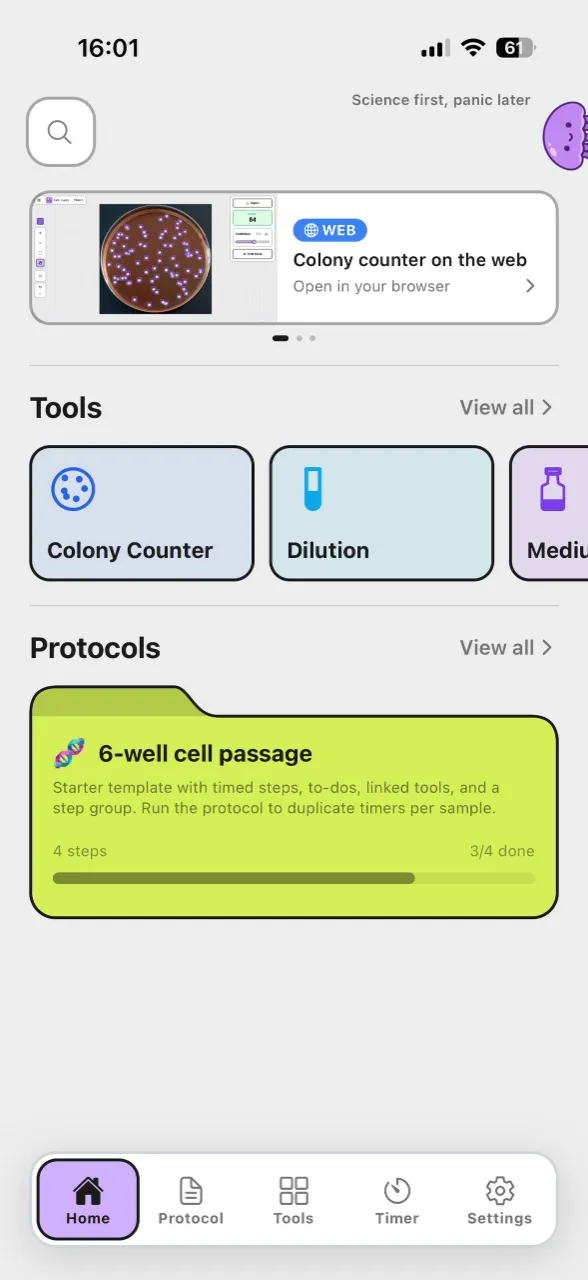
Disciplined documentation pairs naturally with disciplined execution: named phases, consistent sequencing, and timing that matches what you wrote. Lab Laps helps you run multi-step protocols with clear steps and timers—alongside whatever notebook or ELN you use for the permanent record.