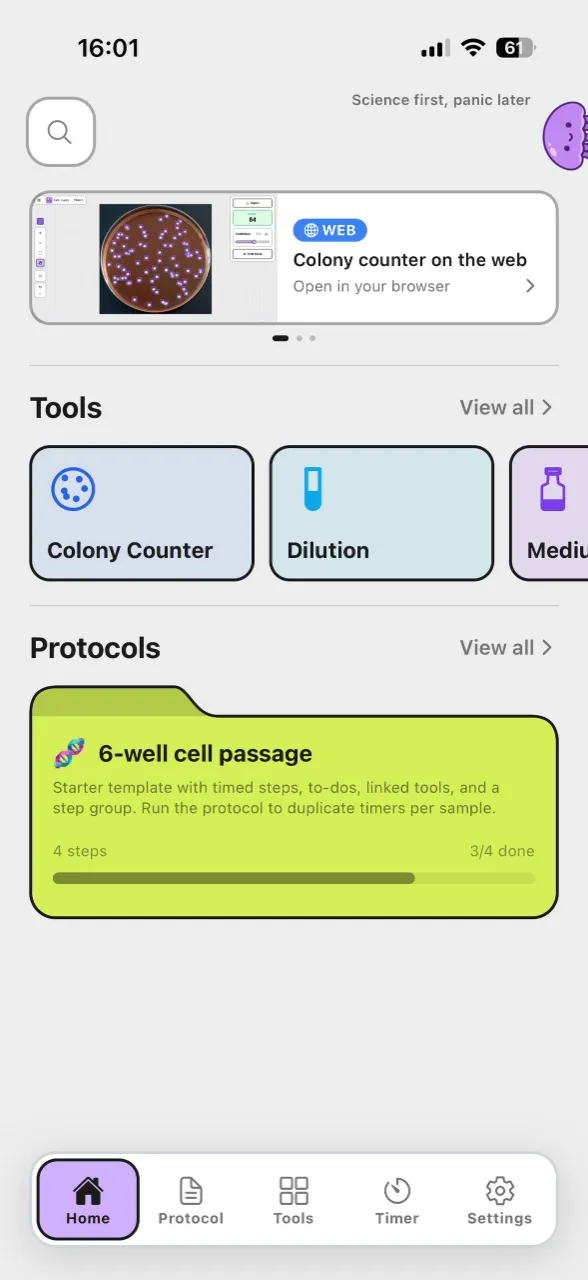


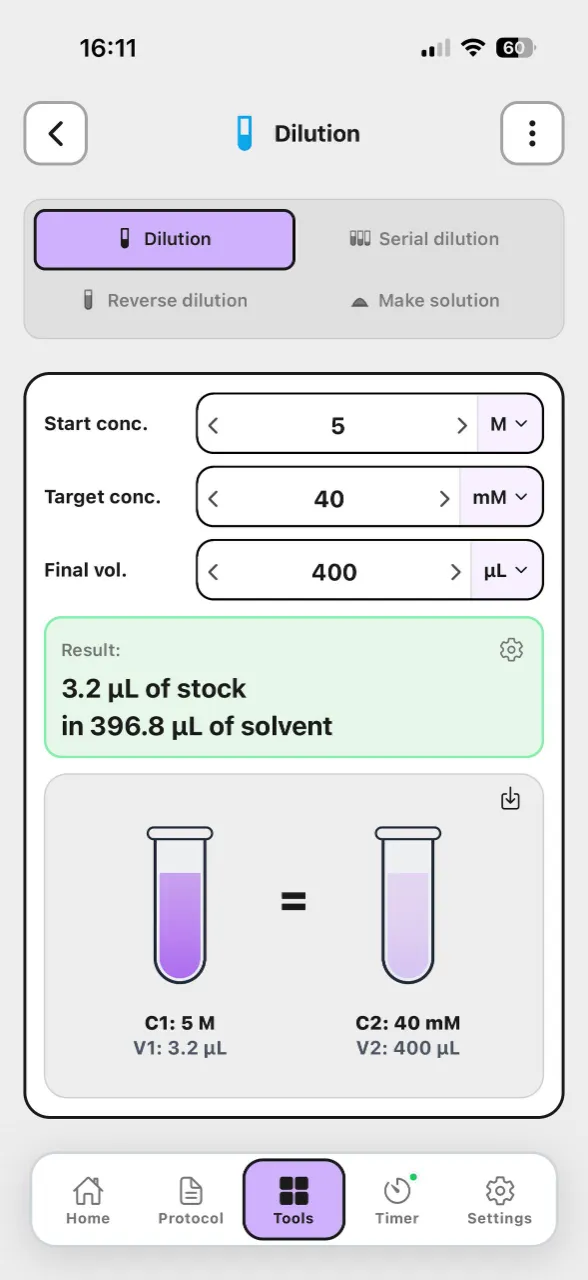
Dilution calculator for labs and protocol workflows
Dilution work is often done under time pressure. A good workflow keeps calculations close to execution so protocol timing and concentration prep stay aligned.
Need a quick C1V1 = C2V2 in the browser? Try the free online dilution calculator.
See dilution workflows in action with lab laps
Comparison table
This table compares common options by live workflow value, not only by calculation features.
Score | Tool | Cost / access | Usability | Protocol tracking | Phone app | Lab tools |
|---|---|---|---|---|---|---|
| 5/5 | Purpose-built protocol runner: named steps, multiple timers, sync across steps, offline use, and one-link sharing. | 4/5 | 5/5 | |||
| 4/5 |  ELN and inventory platform—you can run structured, timed workflows in the web app on desktop; no bench-focused mobile protocol runner. | 2/5 | 3/5 | |||
| 3.5/5 | Flexible docs and databases for lists; you can outline steps but there is no lab-specific timing layer. | 5/5 | 4/5 | |||
| 3/5 |  Digital lab notebook for compliance and archiving—timed notebook workflows on desktop; not a native phone app for live bench protocol timing. | 3/5 | 2.5/5 | |||
| 2/5 |  Excel & Google Sheets Excel & Google SheetsPlan durations in a grid and share files—no native running timers or step workflow while you work. | 5/5 | 3.5/5 | |||
| 1.5/5 |  Timer apps Timer appsPhone or kitchen timers—cheap and immediate, but no named steps, sync across phases, or shareable protocols. | 4/5 | 4.5/5 |


Strong Mixed Weak
Where Lab Laps is a strong fit
- Labs that repeatedly calculate dilutions during active protocol runs
- Teams that want fewer context switches between calculator, timers, and notes
- Workflows where consistency across operators matters
When another approach is enough
- Occasional one-off calculations without shared workflow requirements
- Simple prep tasks where timing and handoff risk are minimal
Frequently asked questions
What makes a dilution calculator useful in the lab?The best dilution workflow is fast, repeatable, and easy to use while running protocol steps, not only as a standalone math tool.
The best dilution workflow is fast, repeatable, and easy to use while running protocol steps, not only as a standalone math tool.
Why combine dilution and protocol tracking?Combining both reduces context switching and lowers the risk of mismatch between calculations, timing, and execution order.
Combining both reduces context switching and lowers the risk of mismatch between calculations, timing, and execution order.
When is a basic calculator enough?A basic calculator may be enough for occasional, low-risk prep where no shared protocol flow or timing coordination is needed.
A basic calculator may be enough for occasional, low-risk prep where no shared protocol flow or timing coordination is needed.